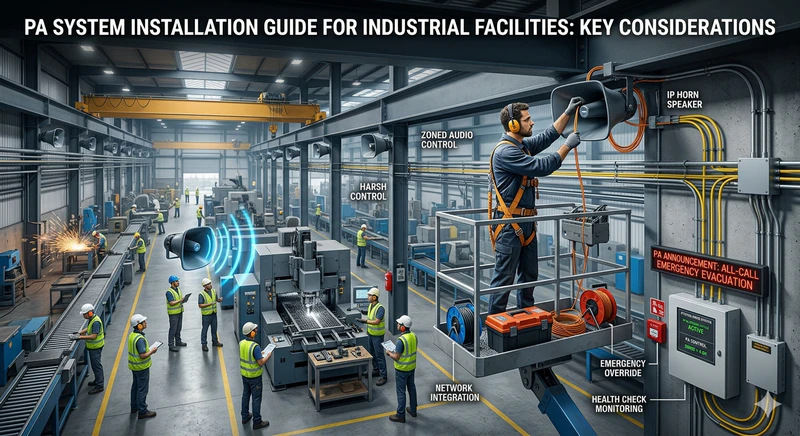
Installing a Public Address (PA) system in an industrial facility is not as straightforward as placing a few speakers and connecting a microphone. Factories, warehouses, and manufacturing plants have unique acoustic, structural, and operational demands. A well-planned PA system can dramatically improve communication, safety, and workflow efficiency—but only if installed correctly.
Here’s a step-by-step guide covering the key technical and practical considerations for a successful PA system installation in industrial environments.
1. Assessing the Communication Objectives
Before you even think about wiring or speakers, define the purpose of your PA system:
- Emergency announcements
- Operational instructions
- Shift change notifications
- Background music or ambient sound
- Paging specific areas or staff members
Having clarity helps determine the equipment, coverage area, and zoning strategy required.
2. Conducting a Site Acoustic Survey
Industrial environments are typically noisy, filled with echoes, heavy machinery, and unpredictable sound behavior. A site survey helps assess:
- Ambient noise levels (in dB)
- Ceiling heights and surface materials (metal, concrete, etc.)
- Reverberation zones
- Power availability
- Accessibility for mounting hardware
Use this survey to decide on speaker wattage, placement, and type.
3. Zoning and Area Division
Dividing the factory into zones allows targeted communication. For example:
- Warehouse floor
- Assembly line area
- Loading dock
- Admin block
- Break room
Each zone may have different audio requirements and volume levels, so choosing a PA system that supports multi-zone control is essential.
4. Speaker Selection and Placement
Choosing the right speaker type is vital:
- Horn Speakers: Ideal for noisy or open industrial spaces; provide loud and directional sound.
- Ceiling Speakers: Best for enclosed, lower-noise zones like control rooms or offices.
- Column or Wall-Mounted Speakers: Good for medium-noise areas and wider coverage.
Placement Guidelines:
- Mount horns above head height, angled down at 45° to minimize echo.
- Maintain even spacing to prevent sound dead zones.
- Use weatherproof or rugged enclosures in areas exposed to dust, water, or vibration.
5. Cabling, Wiring, and Power Supply
Industrial spaces may involve long cable runs, so proper planning is key:
- Use shielded twisted-pair or balanced lines to reduce interference.
- For long distances, consider 70V or 100V line systems for efficient power distribution.
- Use industrial-grade cabling to withstand heat, oil, or chemicals.
- Design redundant power backup via UPS or generator support for critical zones.
6. Amplifier and Mixer Configuration
The amplifier should match the total speaker load with at least 15–20% extra headroom. For large factories, use:
- Multi-channel amplifiers to power different zones independently.
- Digital matrix mixers for zone-based announcements and audio routing.
- Support for mic priority, background music ducking, and pre-recorded messages.
7. Integration with Other Systems
In modern setups, the PA system often integrates with:
- Fire alarm systems (for automatic evacuation alerts)
- CCTV and surveillance systems
- Two-way communication or intercoms
- Building management systems (BMS)
Choose a PA system with flexible I/O ports or IP-based integration for seamless connectivity.
8. Installation and Mounting Best Practices
- Use vibration-proof mounts for speakers near machinery.
- Avoid placing speakers near high-heat or high-voltage zones.
- Label all zones and wiring for easy maintenance.
- Always test each zone individually before full-scale deployment.
9. Testing, Tuning, and Calibration
Post-installation tuning involves:
- Balancing volume levels across zones
- Testing intelligibility in high-noise zones (STI > 0.5 ideal)
- Adjusting delay or EQ to reduce echo
- Verifying emergency override and backup power functions
10. Training and Maintenance
Finally, ensure staff know how to:
- Make announcements clearly
- Use zone selection properly
- Mute background music during alerts
- Perform basic checks on system health
Schedule regular maintenance for amplifiers, speakers, and control units.
Final Thoughts
Installing a PA system in an industrial environment isn’t a one-size-fits-all project. It requires careful planning, specialized equipment, and an understanding of acoustics, safety, and workflow.
At AudioCare, we specialize in designing and installing robust PA systems tailored for factories, warehouses, and manufacturing units. Whether you’re building from scratch or upgrading an outdated system, our team ensures clear, reliable, and safe communication throughout your facility.
📞 Call us at +91 98260 89815
🌐 Visit: www.audiocare.in
🏢 Book a free site survey and consultation with our PA system experts today.
Would you like this turned into a downloadable installation checklist PDF or want to include an equipment recommendation sheet too?