A home theater is no longer limited to large luxury homes or dedicated cinema rooms. With the right planning, homeowners can enjoy an impressive movie-watching experience in a villa, apartment or even a compact living room.
However, every home has different requirements. A spacious villa may offer the flexibility to create a dedicated cinema room with a projector, surround sound and acoustic treatment. An apartment may require a more compact design that integrates naturally with the living room while making the best use of available space.
This is where custom home theater installation becomes important. Instead of choosing a standard package, the system is designed around the room dimensions, seating arrangement, interior design, budget and entertainment preferences of the homeowner.
In this guide, we explore how customised home theater solutions can be planned for villas and apartments, what equipment is required and which factors should be considered before installation.
Why Choose a Custom Home Theater Solution?
A standard home theater package may not suit every room. Speaker sizes, screen dimensions, amplifier capacity and acoustic requirements vary depending on the space.
A customised solution considers the complete environment before recommending equipment.
Some key advantages include:
- Better use of available space: Equipment and seating are planned according to the room layout.
- Improved sound quality: Speaker placement and room acoustics are considered together.
- Suitable display selection: The screen or television is selected according to viewing distance and room lighting.
- Clean installation: Wiring, equipment racks and speakers can be integrated with the interiors.
- Future flexibility: The system can be planned to accommodate additional speakers, streaming devices or automation.
- Budget control: Equipment can be selected according to priorities rather than spending unnecessarily on features that may not be required.
The objective is to create a balanced entertainment experience that works for the actual home.
Custom Home Theater Solutions for Villas
Villas generally offer more flexibility in terms of room size, ceiling height and interior planning. Homeowners may have the option of creating a separate entertainment room or converting an existing room into a private cinema.
1. Dedicated Home Theater Room
A dedicated cinema room is an excellent option when sufficient space is available.
The design can include a large projection screen, a ceiling-mounted projector, surround sound speakers, acoustic treatment, cinema-style seating and controlled lighting.
For a premium setup, the room may also include:
- Multiple rows of recliner seating
- A concealed equipment rack
- Acoustic wall panels and bass traps
- Dark interior finishes to reduce light reflections
- Dimmable lighting and scene control
- Motorised curtains and screen systems
The advantage of a dedicated room is that the display, sound and lighting can be designed together without compromising the everyday use of the space.
2. Premium Living Room Home Theater
Not every villa owner wants a separate cinema room. A premium home theater can also be integrated into a living room.
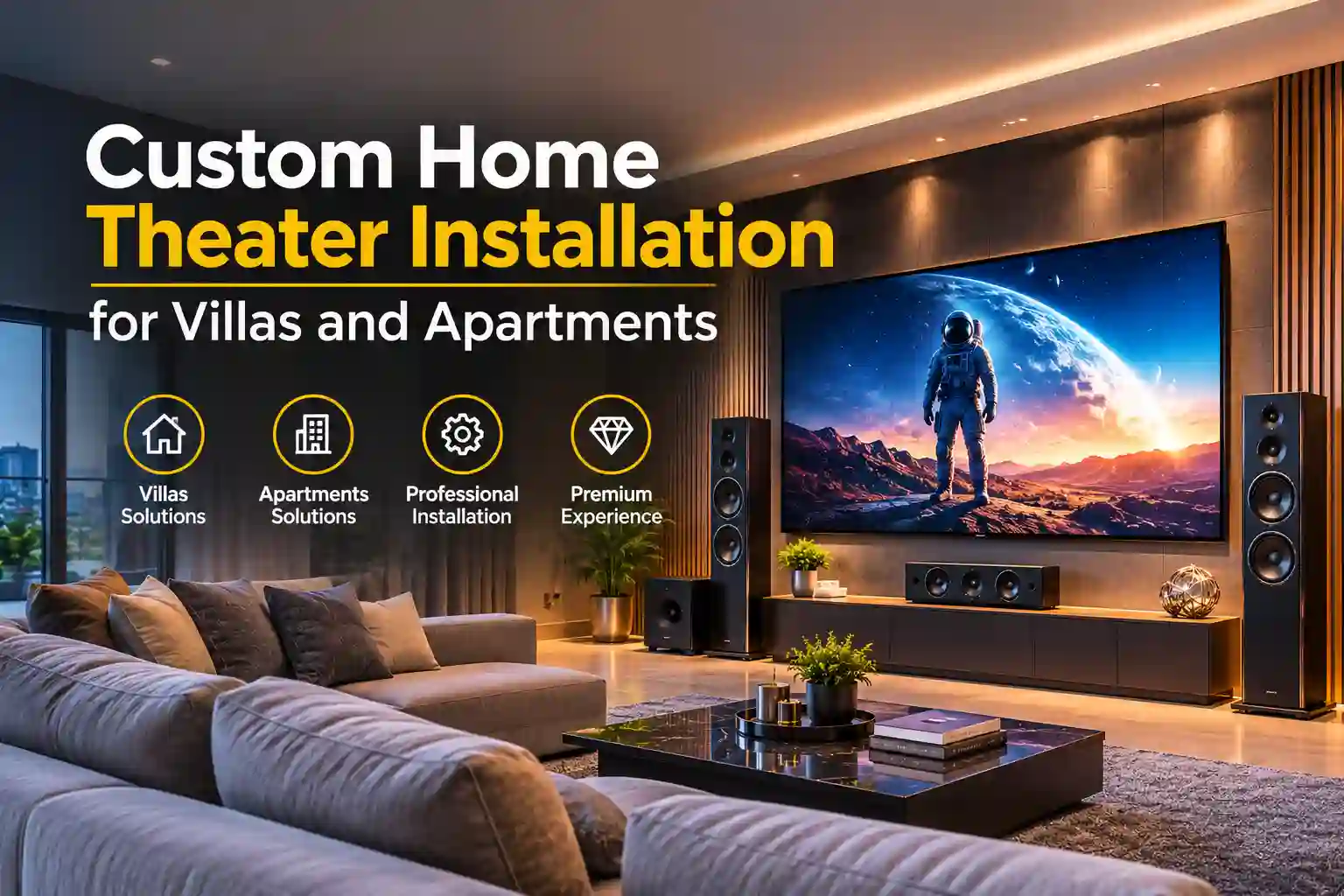
In this arrangement, the system may include a large 4K television or projector, front speakers, a centre speaker, surround speakers and a subwoofer.
The equipment should complement the interior design. In-wall or in-ceiling speakers can be considered where suitable, while floorstanding speakers can become part of the room’s audio setup.
A professional layout helps maintain a good balance between everyday living and home entertainment.
3. Advanced Surround Sound and Dolby Atmos
For homeowners looking for a more immersive experience, a Dolby Atmos-compatible system can be considered.
Unlike conventional surround sound, Dolby Atmos can include height channels that create a more three-dimensional audio experience.
A suitable configuration depends on the room, ceiling structure, speaker positions and AV receiver capabilities. For example, a 5.1.2 system uses five ear-level channels, one subwoofer channel and two height channels.
The configuration should be selected after assessing whether the room can support the required speaker placement.
Custom Home Theater Solutions for Apartments
Apartment installations involve a different set of challenges. Space restrictions, shared walls, ceiling height, wiring routes and building regulations can influence the design.
A well-planned system can still provide an enjoyable cinema experience without requiring a dedicated room.
1. Living Room Home Theater Setup
For most apartments, the living room is the most practical location.
A suitable setup may include:
- A large 4K television or compact projector
- A 5.1 surround sound system
- An AV receiver
- Wall-mounted or compact bookshelf speakers
- A subwoofer positioned according to the room layout
The seating position, television or screen location and speaker arrangement should be planned together. This prevents common issues such as speakers being blocked by furniture or the centre channel being placed too far from the screen.
2. Compact Home Theater for Smaller Apartments
In smaller homes, a carefully selected compact system may perform better than oversized equipment.
Bookshelf speakers, slim speakers, compact subwoofers and wall-mounted displays can help save space.
A soundbar may also be suitable when the room cannot accommodate separate speakers. However, homeowners looking for more precise surround sound and flexibility may prefer a dedicated speaker and AV receiver setup.
The right choice depends on the available space, expectations and budget.
3. Managing Sound in Shared Apartment Buildings
One important consideration in apartments is sound transmission to neighbouring homes.
Low-frequency bass can travel through walls, floors and structural elements. Simply reducing the volume may not completely eliminate this issue.
Possible measures include:
- Choosing a subwoofer with suitable output for the room
- Avoiding excessive bass levels
- Using appropriate isolation solutions where practical
- Positioning speakers and subwoofers thoughtfully
- Considering acoustic treatment and construction-based sound isolation when required
Acoustic treatment and soundproofing are not the same. Acoustic panels improve sound behaviour inside the room, while soundproofing aims to reduce sound transmission between rooms or properties.
For major sound-isolation work, the building structure and available construction space should be assessed before selecting a solution.
Essential Components of a Custom Home Theater System
Whether the installation is planned for a villa or apartment, the main components should be selected as one compatible system.
1. Display: Projector or 4K Television
A projector and screen can create a large cinema-style image, especially in a dedicated room where lighting can be controlled.
A 4K television may be more practical in a living room with windows, regular daylight and frequent everyday use.
The decision should consider viewing distance, screen size, brightness, room lighting and installation requirements.
2. Surround Sound Speakers
Speakers determine how sound is distributed around the listening area.
A typical 5.1 setup includes:
- Front left speaker
- Front right speaker
- Centre speaker
- Two surround speakers
- One subwoofer
Larger rooms may accommodate 7.1 or Dolby Atmos configurations, provided there is sufficient space for suitable speaker placement.
3. AV Receiver
The AV receiver connects and manages the different audio and video components.
Important selection factors include supported speaker channels, Dolby Atmos and DTS compatibility, HDMI inputs and outputs, eARC support, video pass-through capabilities and room correction features.
The receiver should be selected according to the planned system rather than simply choosing the model with the highest power rating.
4. Acoustic Treatment
Acoustic treatment can improve sound clarity, reduce unwanted reflections and help control room reverberation.
Depending on the room, solutions may include acoustic panels, bass traps, carpets, curtains and other appropriate materials.
A dedicated cinema room may require more detailed acoustic planning than a regular living room.
5. Wiring and Smart Home Integration
A custom installation should include a wiring plan for speakers, HDMI connections, networking and power.
In villas, concealed wiring can often be planned during construction or renovation. In apartments, cable routes may need to be adapted to existing interiors.
Smart home integration can also allow homeowners to control lighting, curtains, displays and compatible entertainment equipment through a central interface or automation system.
Key Differences Between Villa and Apartment Home Theater Installations
| Planning Factor | Villa | Apartment |
| Available space | Often more flexible | Usually more restricted |
| Dedicated cinema room | Easier to accommodate where space permits | Depends on layout |
| Speaker configuration | Greater flexibility | Compact configurations may be preferable |
| Acoustic treatment | More scope for customised treatment | Must consider shared walls and space |
| Wiring | Can be planned during construction | Existing routes may limit options |
| Display | Large projection systems are often practical | TV or compact projector may suit better |
| Sound isolation | Can be designed into the room | Building structure and neighbours matter |
These are general planning differences. The actual design should always be based on the individual property.
When Should You Plan Home Theater Installation?
The best time to plan a custom home theater is during the design or renovation stage of a property.
At this stage, it is easier to plan concealed wiring, electrical points, speaker positions, ceiling provisions, lighting circuits and projector mounting locations.
For an existing home, installation is still possible. However, equipment placement and cable routing may need to work around the existing interiors.
Before starting, consider these points:
- Decide whether you want a dedicated cinema room or a living room setup.
- Identify the preferred screen size and seating position.
- Plan the speaker configuration.
- Check electrical and network requirements.
- Evaluate acoustic and sound-isolation requirements.
- Decide whether smart home integration is needed.
- Set a realistic equipment and installation budget.
Planning these details early can reduce changes and additional expenses later.
What Affects the Cost of Custom Home Theater Installation?
There is no single price for a custom home theater because each project has different requirements.
The overall investment depends on:
- Room size and layout
- Number and quality of speakers
- AV receiver specifications
- Projector, screen or television selection
- Acoustic treatment and sound isolation
- Wiring and installation complexity
- Seating, lighting and interior finishes
- Smart home and automation requirements
A compact apartment setup may need a relatively straightforward installation, while a luxury villa cinema can involve extensive acoustic work, multiple speaker channels, projection equipment, customised seating and automation.
A site assessment and equipment discussion are useful steps before preparing an accurate quotation.
Common Mistakes to Avoid
Even premium equipment may not deliver the expected experience if the installation is poorly planned.
Choosing equipment before assessing the room: The room dimensions and layout should influence equipment selection.
Installing too many speakers: More speakers do not automatically mean better sound. Placement and system calibration matter.
Ignoring the centre speaker: The centre channel plays an important role in dialogue clarity and should be positioned appropriately.
Overlooking acoustic conditions: Reflections and bass problems can affect performance even with expensive equipment.
Ignoring future wiring requirements: Plan for likely upgrades and additional connectivity wherever practical.
Focusing only on appearance: Interior design matters, but equipment should remain accessible for maintenance and provide suitable performance.
Why Choose AudioCare for Custom Home Theater Installation?
A successful home theater project requires more than selecting speakers and a television. It involves understanding the room, choosing compatible equipment, planning speaker positions and ensuring that the complete system works together.
AudioCare offers audio and AV consultation and installation solutions for residential and commercial spaces. Its experience includes home theater systems, music rooms, projectors, screens, professional audio systems and customised AV installations.
Whether you are planning a dedicated cinema room in a villa or a compact entertainment setup in an apartment, AudioCare can help assess your requirements and identify a suitable solution.
The focus is on creating an entertainment system that fits the property, complements the interiors and delivers an enjoyable viewing and listening experience.
To discuss your home theater requirements, visit AudioCare or explore its audio system consultation and installation services.
Final Thoughts
Villas and apartments may have very different layouts, but both can accommodate a well-designed home theater system.
A villa may offer the opportunity for a dedicated cinema room with advanced surround sound and projection equipment. An apartment may benefit more from a compact, carefully integrated system that makes efficient use of available space.
The key is to plan the installation around the property rather than trying to fit the same equipment package into every home.
With the right combination of display technology, speakers, amplification, acoustics and professional installation, a customised home theater can bring a more immersive entertainment experience into everyday living.