Music sounds different when you listen through a properly designed Hi-Fi audio system. You can hear the detail in vocals, the separation between instruments, the depth of bass and the natural character of a recording. However, getting this experience at home involves more than purchasing expensive speakers. The room, amplifier, speaker placement, source equipment and acoustic conditions all play an important role.
A well-planned Hi-Fi audio system for home can turn an ordinary living room or dedicated music room into a comfortable listening space. Whether you enjoy classical music, jazz, rock, instrumental tracks or high-quality streaming audio, the right setup can make a noticeable difference.
This guide explains the essential components, room planning, installation process and practical considerations for setting up a Hi-Fi audio system at home.
What Is a Hi-Fi Audio System?
Hi-Fi stands for high fidelity. It refers to an audio system designed to reproduce recorded sound as accurately as possible, with minimal unwanted distortion or alteration.
Unlike basic music systems that prioritise convenience or loudness, a Hi-Fi setup focuses on sound quality. The objective is to reproduce vocals and instruments with clarity, balanced frequency response, good stereo imaging and controlled bass.
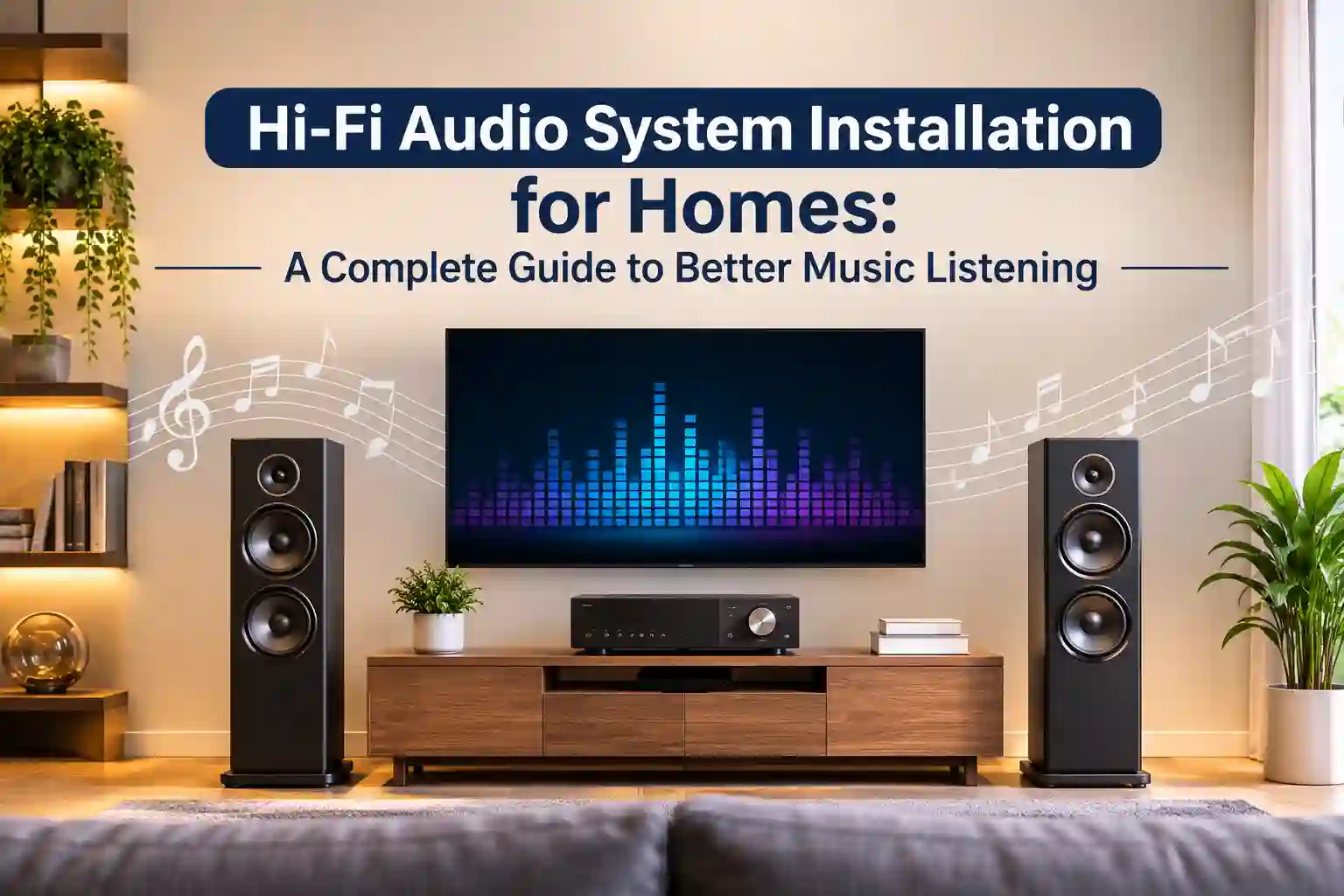
A typical home Hi-Fi system may include:
- Two-channel bookshelf or floorstanding speakers
- An integrated amplifier or stereo amplifier
- A music source, such as a network streamer, CD player or turntable
- A digital-to-analogue converter (DAC), where required
- Suitable speaker and interconnect cables
- Acoustic treatment, depending on the room
Not every home needs every component. A good system should be designed around the listener’s requirements, available space and budget.
Why Install a Dedicated Hi-Fi Audio System at Home?
A dedicated Hi-Fi system offers a different listening experience from portable Bluetooth speakers, television speakers or ordinary all-in-one music systems.
1. Better Sound Clarity and Detail
Quality speakers and amplification can reproduce subtle details in music that may be difficult to hear through basic audio equipment. You may notice clearer vocals, more defined instruments and better separation between different elements of a recording.
2. Proper Stereo Imaging
A well-positioned pair of speakers creates a stereo soundstage. When the system is configured correctly, vocals and instruments appear to occupy specific positions between the speakers rather than sounding like music is simply coming from two boxes.
3. Controlled and Balanced Bass
A good Hi-Fi setup aims for accurate bass rather than simply producing more bass. Speaker selection, room dimensions and placement all influence low-frequency performance.
4. A More Enjoyable Listening Environment
A dedicated listening space allows you to enjoy music without unnecessary background noise or interruptions. Comfortable seating, appropriate lighting and thoughtful room design can further improve the experience.
Essential Components of a Hi-Fi Audio System for Home
Selecting compatible equipment is one of the most important parts of a successful installation. Each component should work well with the others.
1. Bookshelf or Floorstanding Speakers
Speakers have a major influence on the overall sound of a Hi-Fi system.
Bookshelf speakers are suitable for smaller rooms, apartments and compact listening spaces. They can deliver impressive sound when placed correctly on dedicated stands or suitable shelves.
Floorstanding speakers generally offer greater cabinet volume and can provide stronger bass output and a larger presentation. They are often considered for medium and large rooms where sufficient space is available.
The right choice depends on room size, listening distance, amplifier compatibility and personal preference. A larger speaker is not automatically better for every room.
2. Integrated Amplifier
An integrated amplifier combines a preamplifier and power amplifier in one unit. It receives the audio signal, controls volume and provides power to passive speakers.
When selecting an amplifier, consider:
- Power output and speaker sensitivity
- Speaker impedance compatibility
- Available analogue and digital inputs
- Built-in DAC or phono stage, if required
- Network or Bluetooth connectivity, if needed
- Future equipment expansion
The amplifier should be matched with the speakers rather than selected only by its wattage rating.
3. Music Source and Streaming Equipment
Modern Hi-Fi systems can play music from several sources, including:
- Network music streamers
- Smartphones and tablets
- Computers and music servers
- CD players
- Turntables
- High-quality streaming services
If streaming is your primary listening method, a dedicated network streamer can provide convenient access to digital music libraries and supported streaming platforms. Check the supported services, formats and connectivity before purchasing.
4. DAC (Digital-to-Analogue Converter)
Digital music files need to be converted into analogue signals before they can be played through conventional amplifiers and speakers.
Many amplifiers, streamers and CD players already include a DAC. An external DAC may be useful when a system needs particular digital inputs, format support or a different technical configuration. It is not an essential purchase for every listener.
5. Subwoofer (Optional)
A subwoofer reproduces low-frequency sounds and can extend the bass response of a stereo system. It can be useful in larger rooms or when the main speakers have limited low-frequency output.
However, adding a subwoofer requires proper placement and integration. Incorrect settings can make the bass sound excessive or disconnected from the main speakers.
How to Choose the Right Hi-Fi System for Your Room
The best equipment on paper may not deliver the best results in your home. Room conditions and listening habits should influence the system design.
Small Rooms and Apartments
For compact spaces, quality bookshelf speakers paired with a suitable integrated amplifier can be an excellent starting point.
Avoid choosing large speakers simply because they appear more premium. In a small room, excessive bass energy can create an uneven listening experience.
Medium-Sized Living Rooms
A medium-sized living room can accommodate bookshelf or floorstanding speakers, depending on the layout and available space.
Consider where the speakers will be positioned, how far away listeners will sit and whether furniture or walls will obstruct the sound.
Dedicated Music Rooms
A dedicated music room provides greater control over speaker placement, seating and acoustic treatment. It may also allow the installation of larger speakers, dedicated equipment racks and separate source components.
For a serious music enthusiast, planning the room before buying equipment can help avoid expensive adjustments later.
Why Room Acoustics Matter in Hi-Fi Audio Installation
Even high-quality speakers can sound disappointing in a room with poor acoustics.
Sound reflects from walls, floors, ceilings, windows and furniture. These reflections interact with the direct sound from the speakers and can affect clarity, stereo imaging and bass response.
Common acoustic issues include:
- Excessive echo and reverberation
- Bass build-up in room corners
- Uneven bass response at the listening position
- Strong reflections from bare walls and glass surfaces
- Poor stereo imaging due to unsuitable speaker placement
Acoustic treatment can help address these problems.
Depending on the room, suitable solutions may include acoustic panels, bass traps, rugs, curtains and carefully selected furnishings. The requirement should be identified through room assessment rather than installing panels randomly.
It is also important to understand that acoustic treatment and soundproofing are different. Acoustic treatment improves sound inside the room, while soundproofing aims to reduce sound transmission between spaces.
Best Speaker Placement for Better Stereo Sound
Speaker placement is one of the most important and often overlooked parts of a Hi-Fi installation.
A good starting point is to position the two speakers at a similar distance from the main listening position, forming an approximately equal-sided triangle.
Consider the following installation guidelines:
- Keep the left and right speakers at similar distances from the listening position.
- Maintain appropriate distance from the front and side walls, following the speaker manufacturer’s recommendations.
- Keep both speakers at a similar height and orientation.
- Experiment with toe-in, which means angling the speakers slightly towards the listener.
- Avoid placing one speaker in a corner while leaving the other in an open area.
- Use suitable stands for bookshelf speakers and ensure stable placement.
These are starting points, not fixed rules. Final positioning should be adjusted by listening and, where useful, measurement.
Wired vs Wireless Hi-Fi Audio Systems
Both wired and wireless systems have a place in modern homes.
| Feature | Wired Hi-Fi System | Wireless Hi-Fi System |
| Connectivity | Physical speaker and audio cables | Wi-Fi, Bluetooth or proprietary wireless connections |
| Installation | Requires cable planning | Often simpler equipment placement |
| Flexibility | Depends on cable routes | Easier to reposition compatible devices |
| System design | Offers broad component-matching options | Depends on supported ecosystem |
| Best suited for | Dedicated listening rooms and planned installations | Convenient everyday music listening |
A wired passive-speaker system is a common choice for traditional two-channel Hi-Fi listening. Wireless speakers and streaming amplifiers can be suitable when convenience, minimal cabling and multi-room playback are priorities.
The right solution depends on how you use music at home.
Professional Hi-Fi Audio System Installation: What Does the Process Involve?
A professional installation begins with understanding the room and the listener’s expectations. Simply connecting speakers and an amplifier does not guarantee good sound.
A typical installation involves the following stages.
1. Understanding Listening Preferences
The first step is to understand what type of music you enjoy, how often you listen and whether you prefer background music or focused listening sessions.
2. Room Assessment
The room’s dimensions, layout, furniture, wall materials, windows and electrical points are evaluated. This helps determine suitable speaker types and possible installation positions.
3. Equipment Selection
Speakers, amplifiers, streamers and other components are selected according to compatibility, performance requirements and budget.
4. Cable and Power Planning
Speaker cables, interconnects, network connections and power points should be planned neatly. Concealed wiring may be considered during construction or renovation.
5. Installation and Configuration
The equipment is installed, connections are checked and system settings are configured. Speaker positioning and subwoofer integration are adjusted where applicable.
6. Listening Tests and Fine-Tuning
The final stage involves listening tests and adjustments to speaker placement, channel balance, source settings and other relevant parameters.
Professional setup helps ensure that the equipment performs as a complete system rather than as a collection of separate components.
Common Mistakes to Avoid When Setting Up a Home Hi-Fi System
Even a costly system may not perform well if basic planning is overlooked.
Choosing speakers without considering the room: Speaker size and design should suit the room and listening distance.
Spending the entire budget on speakers: Amplification, source equipment, cables, stands and installation also need to be considered.
Ignoring speaker placement: Positioning has a significant effect on stereo imaging and bass response.
Buying unnecessary equipment: External DACs, separate power amplifiers and subwoofers should be added only when they serve a clear purpose.
Ignoring future connectivity: Consider how you plan to stream music and connect other devices over the coming years.
Skipping listening tests: If possible, audition shortlisted equipment with familiar music before making a purchase.
How Much Does a Hi-Fi Audio System for Home Cost?
The cost depends on the quality and type of equipment, room size, installation requirements and level of customisation.
A simple stereo setup with bookshelf speakers and an integrated amplifier will generally require a smaller investment than a premium system with floorstanding speakers, separate components, a dedicated streamer and acoustic treatment.
Rather than selecting equipment based on price alone, divide the budget across the main components:
- Speakers
- Amplifier
- Music source or streamer
- Cables and accessories
- Stands or equipment rack
- Acoustic improvements
- Installation and configuration
A professional consultation can help prioritise components and avoid spending money on features that do not meaningfully improve the listening experience.
Why Choose AudioCare for Home Hi-Fi Audio Installation?
Designing a good Hi-Fi system requires an understanding of audio equipment, room acoustics, speaker positioning and system compatibility. The objective is to create a listening experience that suits the home, not simply to install expensive products.
AudioCare provides audio consultation and installation solutions for residential and commercial spaces. With experience in audio systems, home entertainment and music room planning, the team can help homeowners evaluate their requirements and select an appropriate setup.
Whether you are planning a compact stereo system for your living room or a dedicated music listening room, professional guidance can help you make informed decisions about speakers, amplification, connectivity and installation.
To discuss a Hi-Fi audio system for your home, visit AudioCare or Contact the team for a consultation.
Final Thoughts
A well-designed Hi-Fi audio system can make music listening at home far more engaging. However, sound quality depends on the complete setup: speakers, amplifier, music source, room acoustics and installation.
Start by understanding your listening preferences and evaluating the available space. Choose compatible equipment, plan speaker placement carefully and make acoustic improvements where necessary.
With the right planning and installation, you can build a home audio system that delivers enjoyable, balanced and detailed sound for years to come.