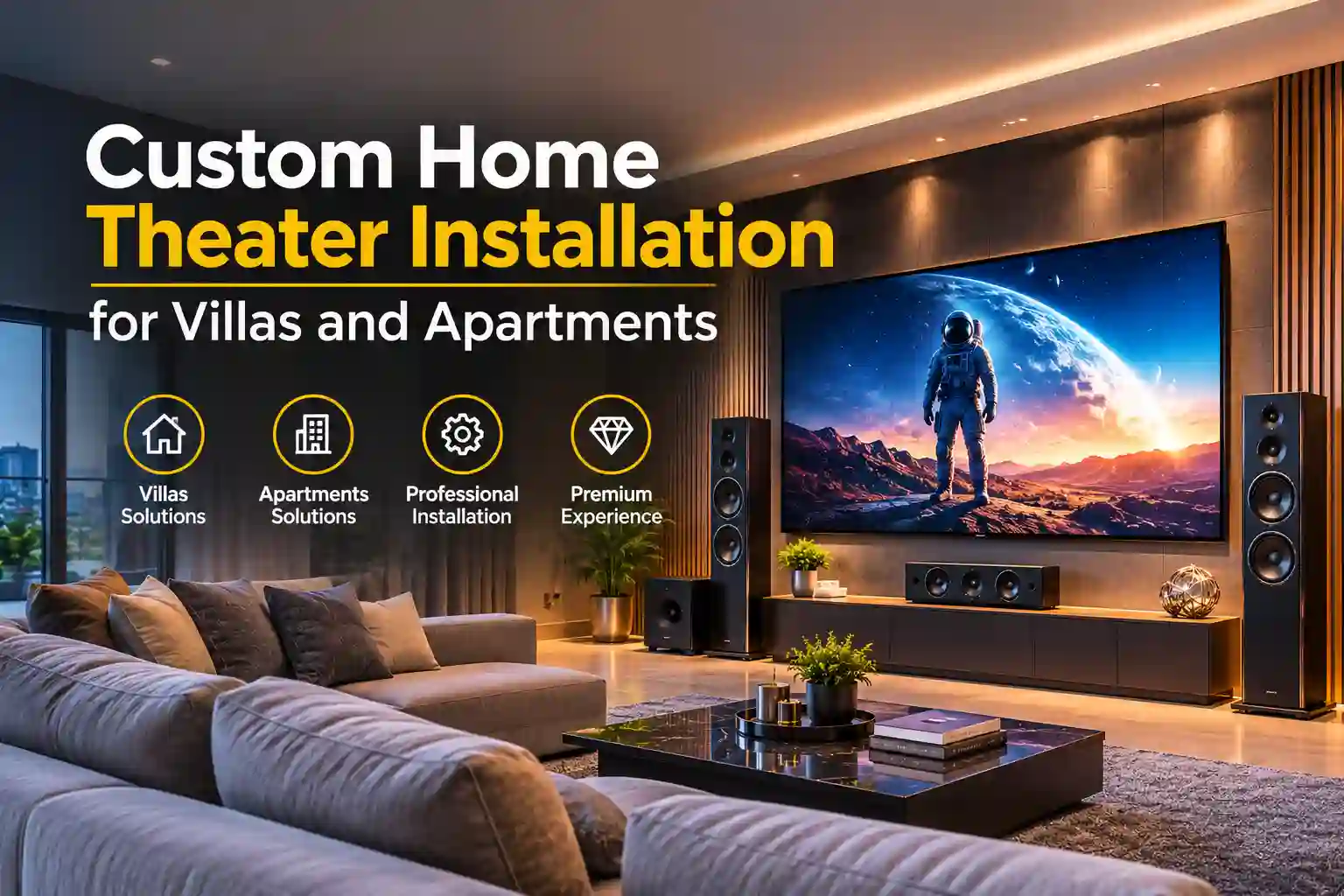
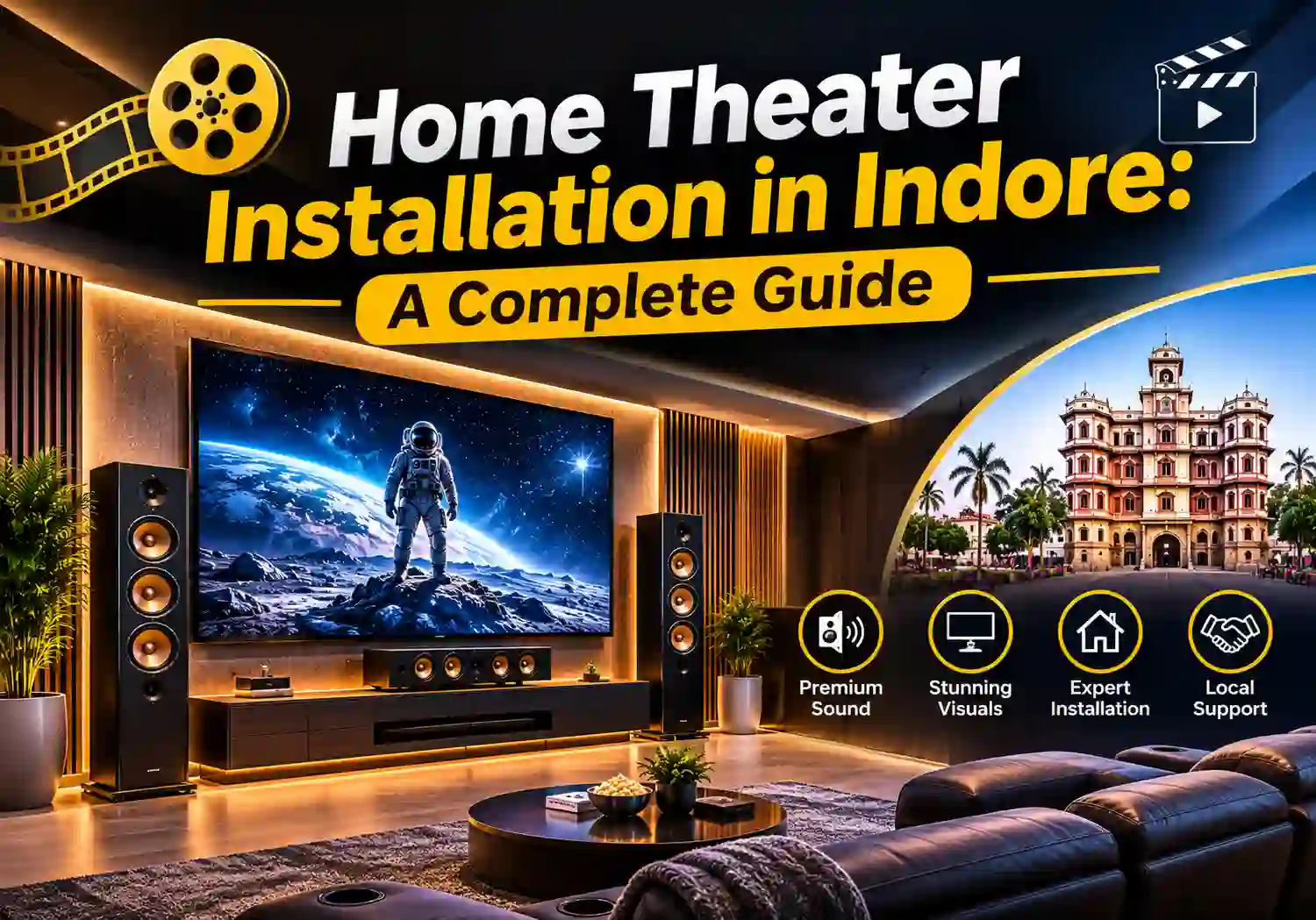
A home theater is more than just a large television and a set of speakers. It is a carefully planned entertainment space that brings together immersive sound, stunning visuals, comfortable seating, and the right lighting to create a cinema-like experience at home.
Whether you are planning a dedicated home theater room in your villa or upgrading the living room in your apartment, the right equipment and professional installation can make a significant difference.
If you are considering home theater installation in Indore, this guide will help you understand the essential components, room planning, speaker placement, acoustic treatment, installation process, and factors to consider before investing in a system.
What Is a Home Theater System?
A home theater system recreates the audio and visual experience of a cinema in a residential setting. Depending on your space and budget, it can range from a simple surround sound setup to a fully customized cinema room with a projector, an acoustically treated interior, and Dolby Atmos speakers.
A typical home theater system includes:
- Display: A large-screen television or projector and projection screen.
- AV Receiver (AVR): The central component that processes audio and connects your source devices to the speakers and display.
- Speakers: Front, center, surround, and optional height speakers for immersive sound.
- Subwoofer: Reproduces low-frequency effects for deeper bass.
- Source devices: Streaming devices, gaming consoles, Blu-ray players, or set-top boxes.
- Connectivity: HDMI cables, speaker wiring, and other connections required by the system.
- Room acoustics: Treatments that help control reflections, echoes, and bass response.
- Seating and lighting: Elements that improve comfort and the overall viewing experience.
The right combination depends on how you plan to use the room, its dimensions, and your entertainment preferences.
Why Consider Professional Home Theater Installation in Indore?
Buying good equipment is only one part of building a home theater. The placement, configuration, wiring, and acoustic characteristics of the room all influence the final result.
Professional installation helps bring these elements together into a system that performs as intended.
1. Better Sound Quality
Speaker placement affects dialogue clarity, surround effects, and the balance between different channels. A properly configured system helps create a more convincing and consistent listening experience.
2. Immersive Surround Sound
Modern systems can support surround sound formats such as Dolby Atmos, depending on the selected equipment. With the appropriate speaker arrangement, sounds can appear to come from different directions, including overhead.
3. Clean Wiring and Equipment Integration
Carefully planned wiring helps reduce visible cables and makes the system easier to maintain. It also helps ensure that the AVR, display, speakers, and source devices work together correctly.
4. Better Use of Available Space
Not every home has a dedicated cinema room. Professional planning can help homeowners make effective use of a living room, spare bedroom, basement, or entertainment area.
5. Scope for Future Upgrades
A well-planned installation can account for potential upgrades, such as additional surround speakers, ceiling speakers, a better projector, or a more capable AV receiver.
Dedicated Home Theater Room vs Living Room Setup
Before selecting equipment, decide where you want to install your home theater.
| Feature | Dedicated Home Theater | Living Room Home Theater |
| Main purpose | Immersive cinema experience | Everyday entertainment |
| Lighting control | Easier to control | Shared with other activities |
| Acoustic treatment | More scope for customization | Usually more limited |
| Speaker placement | Greater flexibility | Must work with furniture and room layout |
| Display options | Large projector screen or TV | Often a large television |
| Room design | Can be customized around cinema use | Must complement the existing interior |
A dedicated room is ideal if movies and immersive entertainment are a priority. A living room setup may be more practical for families who want a system for films, sports, gaming, and everyday television.
Both options can deliver excellent results when planned correctly.
How to Choose the Right Home Theater System
The best home theater system is not necessarily the most expensive one. It is the system that suits your room, listening preferences, and budget.
Choose the Right Display
The display is one of the most noticeable parts of a home theater.
A large-screen television can be convenient for everyday use, especially in rooms with ambient light. A projector and screen may be better suited to a dedicated cinema room where you want a larger image.
Consider the following factors:
- Room size and viewing distance
- Available light and window placement
- Screen size and resolution
- HDR compatibility
- Gaming and streaming requirements
- Installation and cable-routing options
For projector installations, room lighting and screen selection can have a substantial effect on perceived picture quality.
Select the Appropriate Speaker Configuration
Home theater systems are commonly described using channel configurations.
| Configuration | Description | Best Suited For |
| 2.1 | Two main speakers and one subwoofer | Basic music and movie enhancement |
| 5.1 | Five main surround channels and one subwoofer | A popular entry point for surround sound |
| 7.1 | Seven main surround channels and one subwoofer | Rooms that can accommodate additional surround speakers |
| 5.1.2 | Five main surround channels, one subwoofer, and two height channels | Adding overhead effects with compatible content |
| 7.1.4 | Seven main surround channels, one subwoofer, and four height channels | More advanced immersive audio setups |
The numbers describe the speaker channels, not necessarily the number of physical speaker cabinets. For example, multiple subwoofers can be used in some systems.
Choose a configuration based on your room dimensions, seating positions, AVR capabilities, and the type of experience you want.
Choose the Right AV Receiver
The AV receiver connects and manages the main audio and video components.
When selecting an AVR, consider:
- The number of supported speaker channels
- Power requirements and speaker compatibility
- Dolby Atmos or DTS:X support, if required
- HDMI connectivity and supported video features
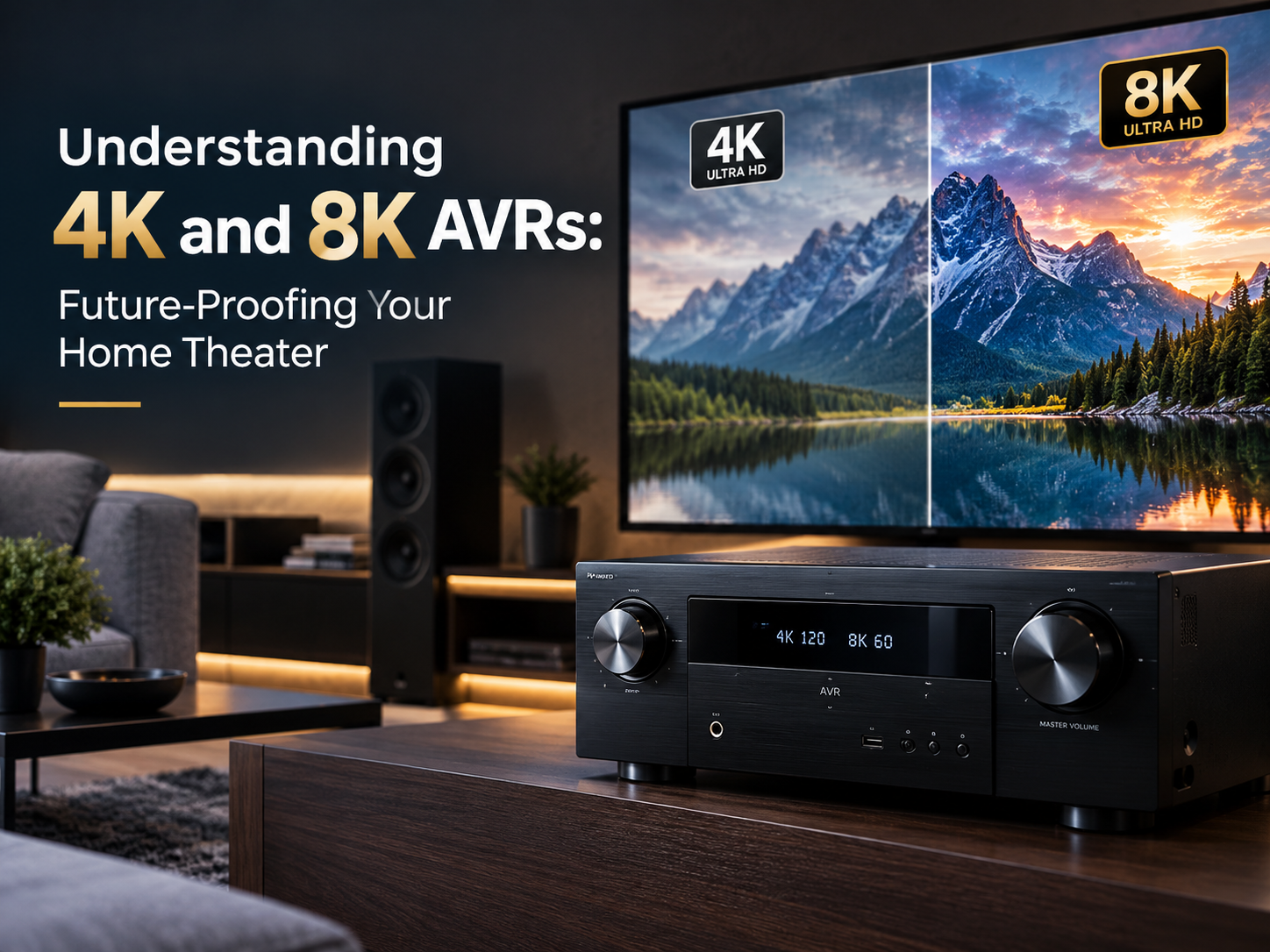
- 4K or 8K pass-through requirements
- eARC support
- Room correction and calibration features
- Connectivity for future upgrades
It is important to check the specifications of the complete system. A receiver may advertise a particular video resolution but still lack a specific HDMI feature you need.
Don’t Overlook the Subwoofer
A subwoofer reproduces low-frequency sounds, including the bass and impact effects in movies.
Its performance depends on more than its power rating. Room dimensions, placement, crossover settings, and interaction with the other speakers all affect the result.
Professional setup can help achieve deeper, more balanced bass without excessive boominess.
Home Theater Room Design and Acoustics
Room design is one of the most important parts of a successful installation.
Even premium speakers can sound disappointing in a room with strong reflections, uneven bass, or poorly planned seating.
Plan the Seating and Viewing Distance
Arrange seating so viewers have a comfortable view of the screen and a suitable relationship with the speaker layout.
Consider the number of viewers, screen dimensions, viewing angle, and available space before finalizing furniture placement.
If the room has multiple seating rows, speaker coverage and screen visibility should be checked for each row.
Improve Room Acoustics
Acoustic treatment helps manage sound reflections within a room. Depending on the space, this may involve absorption panels, bass traps, diffusers, rugs, curtains, or carefully selected furnishings.
Common problems include:
- Excessive echo
- Unclear dialogue
- Boomy or uneven bass
- Strong reflections from hard surfaces
- Inconsistent sound between seating positions
Acoustic treatment is different from soundproofing. Treatment improves the sound inside the room, while soundproofing aims to reduce sound transmission to adjoining spaces. A dedicated home theater may require both, depending on the property and usage.
Plan Lighting and Ventilation
Lighting should support viewing without creating unwanted reflections on the display. Dimmable lights and separate lighting zones can be useful in a dedicated cinema room.
Ventilation is also important. Projectors, AV receivers, amplifiers, and other equipment generate heat and need adequate airflow. Enclosed equipment cabinets should be designed to prevent overheating.
Home Theater Installation Process
A professional installation typically involves several stages, from initial planning to final testing.
Step 1: Site Inspection and Consultation
The installer assesses the room, dimensions, existing electrical infrastructure, lighting, seating requirements, and preferred equipment.
This stage helps establish the scope of work and identify any construction or renovation requirements.
Step 2: System Design and Equipment Selection
Based on the assessment, the system is designed around the required display, AVR, speakers, subwoofer, connectivity, and room acoustics.
The equipment list should reflect the actual needs of the room rather than simply choosing products by brand or price.
Step 3: Wiring and Infrastructure
Speaker cables, HDMI cables, power connections, and any required network cabling are planned before the room is finished.
For new homes and renovation projects, this stage is particularly important because concealed wiring is easier to install before walls and ceilings are completed.
Step 4: Speaker and Display Installation
The speakers, subwoofer, TV or projector, and screen are installed in their planned positions.
Mounting methods, cable routes, ventilation, and access for future maintenance should be considered.
Step 5: Configuration and Calibration
The AVR is configured for the installed speaker layout. Speaker distances, levels, crossover settings, and available room-correction features are adjusted.
The display and source devices are also checked for compatible video settings and signal handling.
Step 6: Final Testing and Demonstration
The installer tests the system with different types of content, including dialogue, music, surround effects, and video sources.
The final handover should include basic operating instructions so that everyone in the household can use the system comfortably.
How Much Does Home Theater Installation Cost in Indore?
The cost of home theater installation in Indore varies according to the equipment selected, room size, installation complexity, and level of customization.
A simple living room setup may require only a television, AVR or compatible audio system, speakers, and basic installation. A dedicated home cinema may require a projector, screen, multiple speakers, acoustic treatment, concealed wiring, seating, lighting, and interior work.
The main factors affecting the overall cost include:
- Brand and model of speakers and AV receiver
- Number of audio channels
- Television or projector and screen selection
- Subwoofer specifications
- Acoustic treatment and soundproofing requirements
- Cable routing and electrical work
- Mounting and installation complexity
- Custom furniture, seating, and lighting
- Smart home integration and future expansion
For an accurate estimate, request a quotation based on your room dimensions, preferred system configuration, equipment requirements, and installation scope.
Comparing quotations is easier when each one clearly separates equipment, installation, cabling, acoustic work, and any additional civil or interior work.
Common Home Theater Installation Mistakes to Avoid
Buying Equipment Before Planning the Room
Selecting speakers and a projector before checking room dimensions can lead to poor placement and unnecessary expenses.
Ignoring Speaker Placement
Incorrect placement can weaken surround effects and create an unbalanced listening experience.
Choosing a Projector Without Considering Ambient Light
A projector that looks impressive in a showroom may deliver disappointing results in a bright room without suitable light control.
Neglecting Acoustics
Hard walls, bare floors, and large reflective surfaces can affect clarity and bass response.
Forgetting Future Connectivity Requirements
Insufficient HDMI inputs, limited cable access, or inadequate space for additional speakers can make future upgrades difficult.
Focusing Only on Equipment Brands
Good equipment matters, but system design, installation, calibration, and after-sales support also influence the overall experience.
Home Theater Installation for Apartments and Villas in Indore
Different residential properties have different installation requirements.
Home Theater for Apartments
Apartment installations often need to balance sound quality with available space and consideration for neighbouring homes.
A carefully selected speaker configuration, suitable subwoofer placement, acoustic planning, and sensible listening levels can help create a satisfying experience without unnecessary disruption.
Where sound transmission is a concern, the feasibility of soundproofing should be assessed before installation.
Home Theater for Villas and Independent Homes
Villas and independent homes may offer more flexibility for dedicated cinema rooms, larger screens, concealed wiring, multiple seating rows, and advanced surround sound.
Planning during construction or renovation can make it easier to integrate speakers, lighting, ventilation, and equipment racks into the room.
Why Choose AudioCare for Home Theater Solutions?
Choosing a home theater provider involves more than finding someone who can supply speakers and a receiver. You need a solution that considers the room, equipment compatibility, installation requirements, and your long-term entertainment needs.
AudioCare provides audio and visual solutions for residential and commercial environments, with services covering consultation, equipment selection, installation, and support.
For your home theater project, the planning process should focus on:
- Understanding your room and entertainment preferences
- Selecting compatible audio and video equipment
- Planning speaker placement and connectivity
- Considering acoustics, lighting, and ventilation
- Installing and configuring the complete system
- Allowing for maintenance and future upgrades
Whether you are planning a dedicated cinema room or improving your living room entertainment system, a tailored approach can help you get more from your investment.
Visit the AudioCare website to explore its audio and visual solutions:https://www.audiocare.in/
Final Thoughts
A well-designed home theater brings together high-quality audio, clear visuals, comfortable seating, and a room layout that supports an immersive entertainment experience.
If you are planning home theater installation in Indore, start by evaluating your room, deciding between a television and projector, selecting the right speaker configuration, and planning the necessary wiring and acoustics.
Professional design and installation can help ensure that all the components work together properly, making your home theater enjoyable today and easier to upgrade in the future.
Contact AudioCare to discuss your home theater requirements and explore a solution suited to your home, room size, and entertainment preferences.