
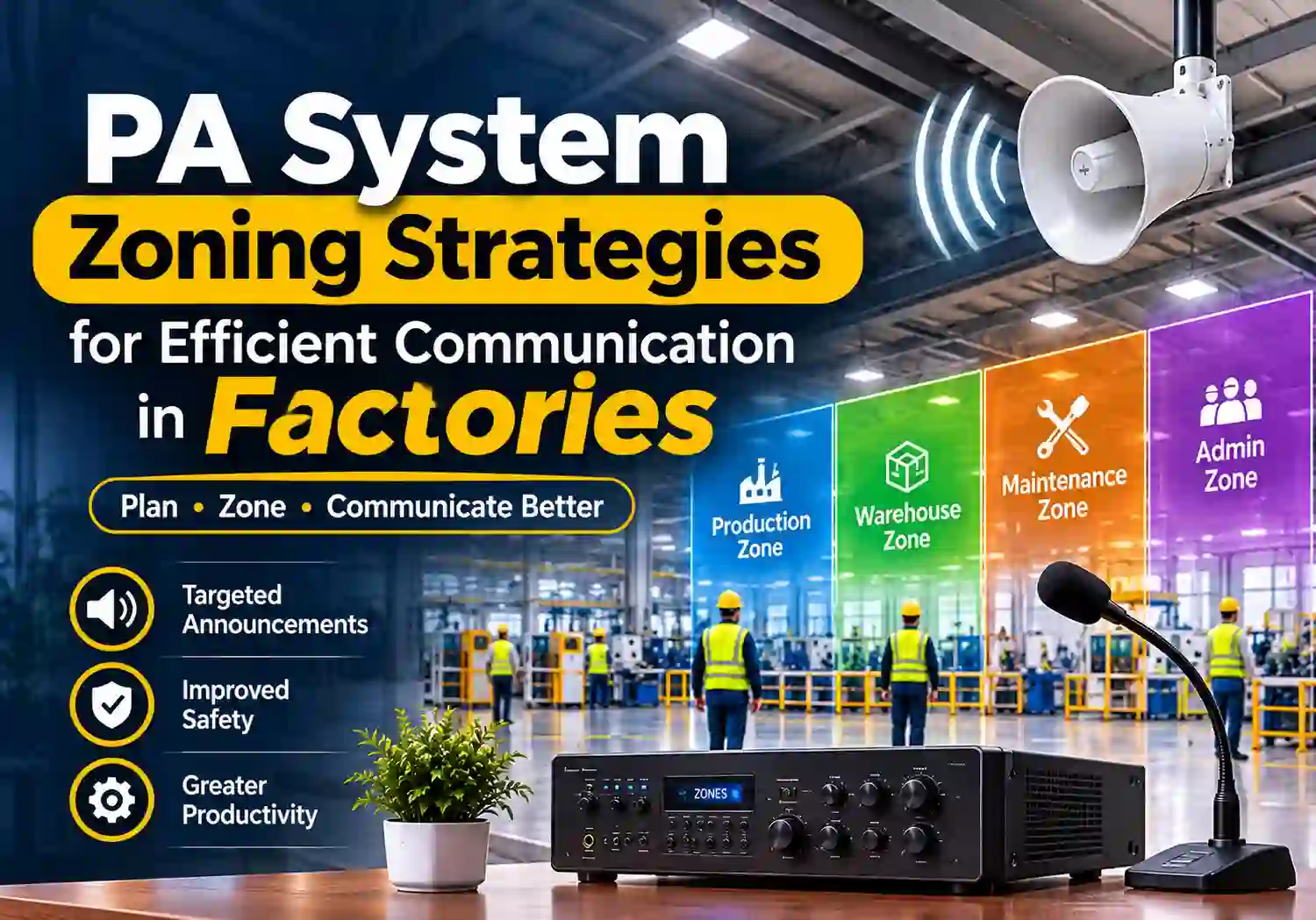
In a factory, clear communication is essential for smooth operations, worker coordination, and workplace safety. Whether it is announcing a shift change, sharing production updates, communicating maintenance instructions, or broadcasting an emergency alert, messages need to reach the right people at the right time.
However, factories are rarely made up of a single open space. They may include production floors, warehouses, loading bays, offices, workshops, quality control areas, and outdoor yards. Broadcasting every announcement across the entire facility can create unnecessary noise and disrupt work.
This is where PA system zoning becomes important. A well-planned Public Address (PA) system allows factory management to communicate with specific departments or areas without disturbing the entire facility.
What Is PA System Zoning?
PA system zoning is the process of dividing a factory into separate audio coverage areas, or zones. Each zone can receive announcements independently or as part of a facility-wide broadcast, depending on the system design.
For example, a factory might have separate zones for:
- Production and assembly lines
- Raw material storage
- Finished goods warehouses
- Loading and unloading areas
- Administrative offices
- Maintenance workshops
- Canteens and break rooms
- Outdoor yards and parking areas
With a zoned PA system, a supervisor can make an announcement specifically for the production floor while the administrative office continues working without unnecessary interruptions.
The goal is simple: deliver the right message to the right people without creating noise across the entire facility.
Why Is PA System Zoning Important in Factories?
1. Targeted Communication
Different departments need different information. Production workers may need instructions about a machine shutdown, while warehouse staff may need updates about incoming deliveries.
Zoning allows announcements to be directed to the relevant area instead of broadcasting every message throughout the factory.
2. Improved Workplace Safety
Factories often contain machinery, moving vehicles, material-handling equipment, and areas with restricted access. During an incident, communicating instructions quickly and clearly can be critical.
A zoned PA system can help broadcast warnings to affected areas or send instructions across the entire facility when necessary.
For emergency and evacuation announcements, the system must be designed in accordance with applicable fire and life-safety requirements. Ordinary PA zoning should not be assumed to provide a compliant emergency voice alarm system.
3. Reduced Noise and Disruption
Frequent announcements across an entire factory can interrupt production, meetings, and other activities.
With zoning, routine messages can be restricted to the areas where they are needed. This helps maintain a more controlled working environment while keeping communication accessible.
4. Better Coordination Between Departments
Manufacturing, quality control, logistics, maintenance, and administration often operate independently but need to coordinate throughout the day.
A zoned PA system helps communicate shift schedules, maintenance updates, dispatch instructions, and operational changes without requiring employees to move between departments.
5. Greater Flexibility as the Factory Expands
Factories often add production lines, warehouses, or new buildings over time. A properly designed PA system can accommodate additional zones, speakers, amplifiers, and paging stations as operational requirements change.
Planning for future expansion during the initial installation can reduce the cost and complexity of later upgrades.
How to Divide a Factory Into PA System Zones
Effective zoning starts with understanding how the factory operates. Simply dividing a building according to its floor plan may not provide the best results.
The zoning plan should consider operational activities, noise levels, communication requirements, and the people who need to receive each announcement.
Zone 1: Production and Assembly Areas
Production floors are often noisy, with machinery, conveyors, tools, and other equipment operating simultaneously.
The PA system should provide clear speech coverage without relying on excessive volume.
Recommended considerations include:
- Use suitable industrial speakers based on the environment and required coverage.
- Position speakers to distribute sound evenly across workstations.
- Consider ambient noise when determining speaker type and placement.
- Separate high-noise production areas from quieter departments where practical.
- Test speech intelligibility while machinery is running.
For particularly noisy areas, visual notification devices or other communication methods may be needed alongside audio announcements.
Zone 2: Warehouse and Storage Areas
Warehouses typically feature high ceilings, long aisles, loading activity, and moving forklifts. These conditions can make it difficult for workers to hear announcements clearly.
A warehouse may need separate zones for receiving, storage aisles, picking and packing, and dispatch.
When planning coverage, consider speaker placement, mounting height, aisle layout, reverberation, and the potential need for directional speakers. The objective is to make announcements understandable without creating excessive sound levels near the loading docks or adjacent offices.
Zone 3: Loading Docks and Dispatch Areas
Loading docks require frequent coordination between warehouse teams, drivers, supervisors, and dispatch personnel.
A dedicated zone can be used for vehicle arrival announcements, loading instructions, dispatch updates, and operational warnings.
Where outdoor or semi-open conditions exist, select speakers rated for the relevant weather, dust, and environmental exposure.
Zone 4: Administrative Offices and Meeting Rooms
Office areas usually require lower sound levels than production floors.
Separate office zones allow management to communicate essential updates without broadcasting routine industrial announcements into meeting rooms or workspaces.
In some cases, ceiling speakers, paging speakers, or integration with an existing office communication system may be appropriate.
Zone 5: Maintenance and Utility Areas
Maintenance workshops, electrical rooms, compressor rooms, and utility sections may have different acoustic and environmental conditions.
These areas should be evaluated individually. Some may require industrial-grade speakers, while others may be better served by visual alerts or alternative communication methods.
Access restrictions and hazardous-area requirements must also be considered before installing equipment in sensitive industrial locations.
Zone 6: Outdoor Areas and Parking
Large factories may include vehicle yards, security gates, staff parking, and outdoor storage areas.
Outdoor zones help extend announcements beyond the main building. Weather-resistant horn speakers or other suitable outdoor speakers can be selected according to the coverage area and environmental conditions.
Speaker direction and placement are particularly important to prevent sound from spreading unnecessarily into neighbouring properties.
Choosing the Right PA System Architecture
Once the zones have been identified, the next step is choosing the appropriate system architecture.
Centralized PA System
A centralized system manages audio sources, paging, and zone selection from a common control location.
It can be suitable for factories where announcements are managed from a security room, reception, or central control room.
Advantages include centralized management, consistent operation, and the ability to broadcast messages to selected zones or the entire facility.
However, the design must account for cable distances, amplifier capacity, system redundancy, and the consequences of a central equipment failure.
Distributed PA System
In a distributed design, amplifiers or other audio equipment are placed closer to the areas they serve, or the system uses network-connected endpoints across the facility.
This approach can be useful for large factories with multiple buildings, long cable routes, or separate operational areas.
It may simplify some cable runs and allow the system to expand in stages. However, network reliability, power availability, synchronization, and equipment management must be planned carefully.
Network-Based IP PA System
An IP-based PA system sends audio and control signals over an IP network. Depending on the platform, authorized users can select individual zones, groups of zones, or the whole facility from paging consoles or software.
This can be particularly useful for factories with multiple buildings or centralized management requirements.
Before choosing an IP system, check network capacity, redundancy, cybersecurity, power backup, and how paging will continue if part of the network becomes unavailable.
How to Set Up an Effective Factory PA Zoning System
A successful installation requires more than connecting speakers to different amplifier outputs. The system should be designed around real operational requirements.
Step 1: Conduct a Site Survey
Start by assessing the factory layout and identifying areas where announcements are required.
During the survey, review:
- Building dimensions and ceiling heights
- Machinery noise and ambient sound levels
- Indoor and outdoor coverage requirements
- Existing speakers, amplifiers, and cabling
- Power and network availability
- Dust, moisture, temperature, and other environmental conditions
- Emergency communication requirements
A site survey helps determine the number and type of zones, suitable speaker locations, and the equipment needed for reliable coverage.
Step 2: Create a Zone Map
Prepare a factory floor plan showing every proposed PA zone.
Assign each zone a clear name, such as Production Line A, Warehouse, Dispatch, or Administration. Document which paging stations can access each zone and which announcements should be broadcast facility-wide.
The zone map should be easy for supervisors and security personnel to understand, particularly when quick communication is required.
Step 3: Select Suitable Speakers
Speaker selection depends on the environment and the type of announcement.
| Factory Area | Suitable Speaker Options | Key Considerations |
| Production floor | Industrial wall or horn speakers | Machinery noise and speech clarity |
| Warehouse | Horn or suitable distributed speakers | Ceiling height and aisle coverage |
| Office | Ceiling or wall-mounted speakers | Comfortable listening levels |
| Loading dock | Weather-resistant horn speakers | Outdoor exposure and vehicle noise |
| Canteen | Ceiling or wall-mounted speakers | Even coverage and background noise |
| Outdoor yard | Weather-resistant horn speakers | Coverage distance and sound direction |
The final choice should be based on a site assessment rather than the speaker type alone.
Step 4: Calculate Amplifier Capacity and Plan Cabling
The amplifier and cabling design must support the number of speakers and the required coverage.
Many large commercial and industrial PA systems use 70V or 100V distributed speaker lines. These systems can simplify the connection of multiple speakers over longer cable runs.
For a distributed line, the combined speaker tap wattage should be calculated for each amplifier channel, with appropriate capacity reserved according to the system design and manufacturer recommendations.
For example, if a zone has ten speakers tapped at 10 watts each, the total connected speaker load is 100 watts. The amplifier should be selected with suitable headroom and compatibility for that load.
Cable selection, line losses, amplifier placement, and separation from sources of electrical interference should also be considered during installation.
Step 5: Configure Zone Controls
The control system should make it straightforward for authorized staff to select the correct area.
Depending on the system, zone controls may be available through paging microphones, dedicated buttons, network consoles, or software.
A practical configuration should allow users to:
- Make announcements to an individual zone
- Broadcast to selected groups of zones
- Make facility-wide announcements
- Prioritize authorized emergency messages where the system is designed for that purpose
- Restrict access to sensitive controls
Clear zone labels help reduce mistakes, especially when several departments share the same system.
Step 6: Establish Announcement Priorities
Not all announcements have the same importance.
Routine shift updates, operational instructions, general announcements, and emergency messages may need different priority levels.
Define these priorities before commissioning the system. If emergency announcements must override routine paging, the equipment and control logic must explicitly support that function.
Where the PA system forms part of a regulated emergency voice alarm system, the design, monitoring, backup power, and installation must meet the applicable standards and local requirements.
Step 7: Test Every Zone Under Real Conditions
A PA system should be tested in the actual operating environment, not only when the factory is quiet.
During testing:
- Confirm that every speaker operates correctly.
- Check that announcements reach the intended zones.
- Verify that unrelated zones remain unaffected during routine paging.
- Test speech intelligibility while machinery is running.
- Check paging priority and zone selection.
- Confirm that outdoor coverage is adequate.
- Test backup and fault-handling functions where applicable.
Record the results and resolve coverage gaps before handing the system over to the facility team.
Common PA Zoning Mistakes to Avoid
Even a high-quality PA system can deliver poor results if zoning and installation are not planned properly.
Creating too few zones: Combining unrelated departments can lead to unnecessary announcements and interruptions.
Creating too many zones: Excessive segmentation can make the system difficult to operate and increase equipment and configuration complexity.
Ignoring machinery noise: A speaker that sounds clear in a quiet factory may become ineffective during normal production.
Using the same speaker everywhere: Production floors, offices, warehouses, and outdoor yards often require different speaker types and mounting arrangements.
Overlooking emergency requirements: A standard paging system may not satisfy emergency voice alarm requirements.
Failing to plan for expansion: Adding production lines or new buildings can become expensive if the system has no provision for additional zones.
Skipping commissioning and staff training: Employees need to understand how to select zones, make announcements, and follow the established communication procedures.
Benefits of a Well-Designed Factory PA Zoning System
A properly designed and installed zoned PA system can provide several operational benefits:
- More targeted and relevant announcements
- Better coordination between departments
- Reduced disruption to office and production activities
- Improved access to routine safety messages
- More efficient communication across large facilities
- Greater flexibility when operations change
- Easier management of multi-building facilities
The actual benefits depend on the factory layout, system design, operating procedures, and the quality of installation and maintenance.
Why Professional PA System Planning Matters
Every factory has its own communication challenges. A compact manufacturing unit may need only a few zones, while a large industrial facility may require a combination of centralized paging, distributed amplifiers, network-based audio, and dedicated emergency communication infrastructure.
Choosing the right system involves understanding the site’s noise levels, operational workflow, speaker coverage, amplifier requirements, cabling, and future expansion plans.
AudioCare provides professional audio and PA system solutions, including consultation and installation for industrial and commercial environments. A properly planned system can help your team communicate more efficiently while ensuring that announcements reach the areas where they are needed.
Final Thoughts
PA system zoning is an important part of effective communication in factories. By dividing the facility into practical audio zones, businesses can send relevant announcements to specific departments, reduce unnecessary noise, and improve coordination across production, storage, dispatch, and administrative areas.
The most effective approach begins with a detailed site survey, followed by careful zone planning, suitable speaker selection, correct amplifier and cabling design, and thorough testing under real operating conditions.
If you are planning a new factory PA system or upgrading an existing installation, professional zoning can help create a reliable communication system that supports your facility’s current operations and future growth.
Contact AudioCare to discuss your factory’s PA system requirements and plan a solution tailored to your facility.